

Lies, damned lies, and "conservative" statistics
The intriguing tale of a conservative think tank's utterly bizarre conclusions about social trust and ethnicity...

Written by George Francis
In 2001, rockstar academic Robert Putnam produced the Social Capital Community Benchmark Survey. It was a giant survey of 26,700 Americans, asking people a simple question, “How much you can trust people in your neighborhood?” Respondents could respond “a lot”, “some”, “only a little” or “not at all”. Unfortunately for Dr Putnam, upon analysing the data he found an awkward result. The more racially diverse areas had lower levels of social trust. Scared of his findings, Putnam delayed publishing them for six years.
The story has become something of a popular parable among the right-wing. The superficial lesson is that diversity and immigration are bad for the cultural fabric, community and sense of identity — all those nice things which are neatly summarised in how much we trust our neighbours. And despite the lesson being so painstakingly clear, liberals and academics can’t help but bury their heads in the sand!
Of course, there’s more nuance to the world than present in allegory. In reality, it’s not clear that diversity per se reduces social trust. All we actually know is that living around certain races is associated with low social trust. In US countries, having more Asians or Latinos instead of Whites has no association with social trust. Although having more African Americans is strongly associated with lower trust. When you control for the ethnic proportions of all the races, indexes of diversity or homogeneity typically only have a very small relationship with social trust. Emil Kirkegaard provides a useful analysis and literature review here.
Generally, the relationship between diversity itself and social trust is small after you control for other factors.
We should not be sure that associations between ethnicity and trust are completely causal. Some ethnicities may be more likely to move to areas of high trust. Ethnic groups that are economically well-off, such as White or East Asians, can better afford to live in nice communities.
Nor is it clear whether trust is a good or merely a bellwether for other good things. Is trust a necessary ingredient to a functioning society, or do honest, hardworking people produce prosperous communities where we can all trust each other? If you search the academic literature you’ll find hundreds of papers claiming the importance of social trust. It is good for reducing crime, for effective government, entrepreneurship, health, happiness and, of course, GDP!
I would guess that social trust is mostly a by-product of positive things. Do people become criminals because they distrust others? Maybe. Would you distrust your community if you kept being mugged? Most certainly. Across regions of countries, social trust correlates with the average intelligence of regions at around 0.7. When you control for intelligence, social trust seems to have little relationship with positive outcomes. Perhaps trust in our society just reflects its competency.
Knowing the debates around social trust, I was very excited to see a new report, “Good Neighbours”, examining social trust in my home country, England. The conservative think tank, Onward, surveyed 42,000 people to ask them whether they trust others. This is near twice the size of Putnam’s 2001 survey and for a country only a fifth of the size, allowing for accurate and fine-grained analysis. Using the survey, they calculate net trust for regions called ‘Middle layer Super Output Areas’ (MSOAs), by taking the proportion of people who say they trust others and then subtracting the number of people who say they distrust others.
The report carries some hefty prestige. The last director of the think tank left three months ago to be deputy Chief of Staff at Downing Street. And before his directorship, he was an advisor to Prime Minister Theresa May. One of the authors of the report, Luke Stanley, is an advisor to Lord Hague, an ex-leader of the Conservative party.
Most importantly, this research is original. As far as I am aware, this is the first research into social trust at a local level in the United Kingdom. So what did Onward find out about social trust? Do the prior findings replicate in England?
As usual, they find social trust correlates with a whole host of positive outcomes. Lower deprivation, lower crime, fewer welfare claimants, higher voter participation and more Remain-voting in the 2016 EU referendum. Whatever metric you can think of, social trust is correlated with it.
And as usual, the report often blindly assumes that trust is causing positive outcomes rather than being a by-product of them.
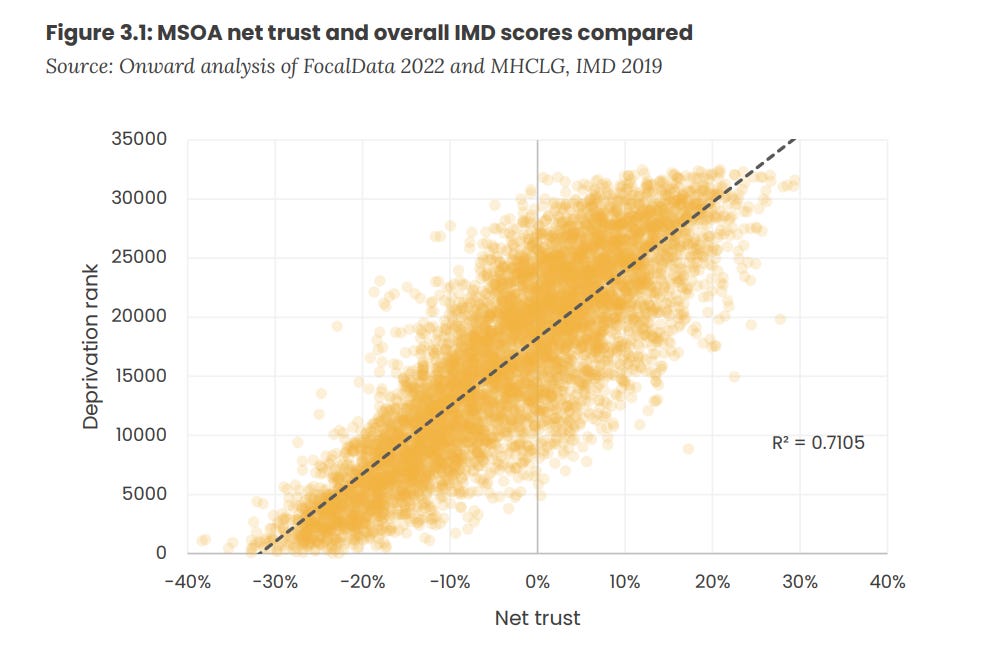
But what about Putnam’s old controversy? What relationship does trust have with immigration, race and diversity? If you search the report for the phrase “ethnic”, you’ll find it mentioned once in the very last paragraph before the conclusion:
“Another area where there is a lack of correlation is ethnic diversity. Looking at the data, there appears to be no link between the proportion of White Britons in a local authority and levels of trust.”
Despite all of the academic literature showing a relationship between ethnicity and trust, Onward says there’s nothing to see here! They expand on this claim ever-so-slightly in a footnote. It states that the proportion of White Britons in local authorities only explains 2.7% of the variation in social trust between local authorities. But that is not nothing. It implies that a standard deviation increase in the proportion of White Britons is associated with a 0.16 standard deviation increase in social trust. With 333 local authorities, it is almost certainly statistically significant too.
Why report the relationship for local authorities? Local authorities have populations in the hundreds of thousands, but the people who live closer to you probably matter much more. The whole point of Onward’s massive survey was to examine social trust at the “hyper-local” level of MSOAs (average population of 7,800). Why shift the analysis to the local authorities just for this particular question?
To obscure the question further, having fewer White Britons in an area might imply having more White Europeans — educated immigrants who easily assimilate. How does Third World immigration affect social trust? When we speak of diversity, we normally mean fewer white people.
Onward only briefly mentions this important topic at the last moment of the report. By switching methodologies, they tried to avoid the elephant in the room. Thankfully, however, Onward has publicly provided the social trust data for the MSOAs. So I thought I would do the analysis myself…
Keep reading with a 7-day free trial
Subscribe to Ideas Sleep Furiously to keep reading this post and get 7 days of free access to the full post archives.
 | A guest post by
|